Strategic Business Planning
Process Handbook
Revision
1.0
Strategic Business Planning
Process Handbook
Revision
1.0
|
Date |
Rev |
Author |
Status |
Last Change |
|
2008-08-14 |
0.1 |
Michael Gries |
Draft |
Initial Draft |
|
2008-09-12 |
1.0 |
Michael Gries |
open |
for review to
all responsibilities |
|
Source Document |
||||
|
<Strategic Business
Planning Process.doc> |
||||
This document describes the generic process for the Strategic Business Planning for Hypercom product development.
This process shall be reviewed on an annual basis, or more often as appropriate by the business review meetings. Any changes required will be made by the Quality Systems Group and versioned.
2. Strategic
Business Planning Process
2.3.1. Flow-oriented
planning chart
2.5.2. Performing
SWOT analysis
2.5.7. Update
Cost Information
2.5.9. Strategic
Business Plan
2.6. Roles
and Responsibilities
4.1. Example
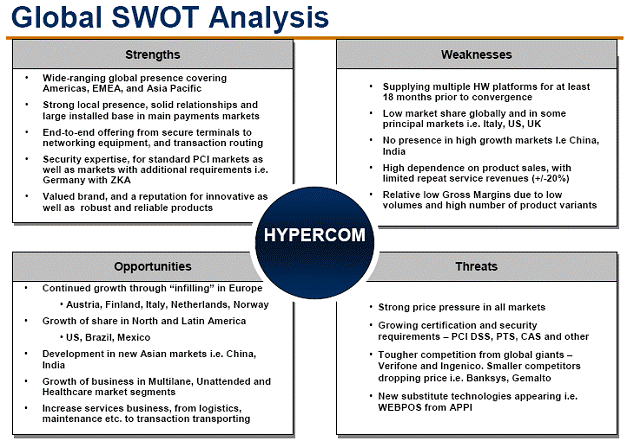
SWOT Analysis 2008
Purpose of the Strategic Business Planning (SBP) process is to evaluate market environment and determine company positioning. The process describes how to prepare major strategic decisions for the company and how to determine and implement key business priorities.
The scope is to create a bottom-up process for business planning over three year timescale which will be evaluated each year.
[1] Quality Systems Manual (t.b.d.)
[2]
Product Life Cycle Handbook,
Rel. 1.0, Arnd Hanstein
[3] Demand And Supply Planning Process Handbook (t.b.d.), David Taylor
[4] Presentation Strategic Business Planning Process, June 2008, Alan Moss
[5] Template (Word) Global SWOT Analysis, Michael Gries
[6] Template (Excel) Market Analysis SBP1, Alan Moss
[7] Template (Excel) Business Analysis SBP1. Alan Moss
[8] Template (Excel) Financials, Bob Vreeland
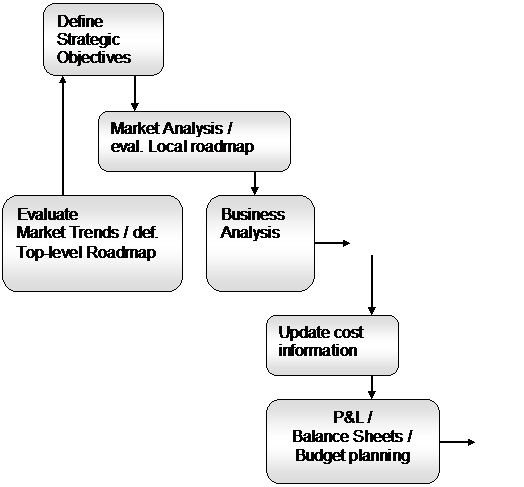
The Strategic Planning process consists to two different phases.
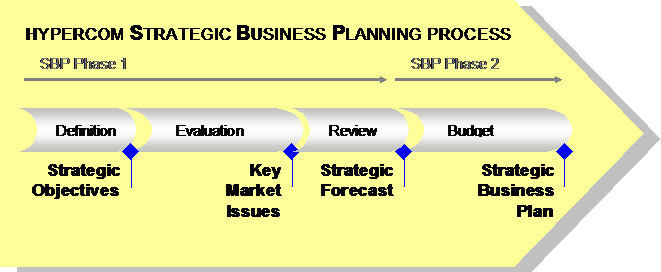
At the beginning of an annual business planning the existing Business Objectives should be reviewed and updated if required. This has to be done in accordance with the Strategic Committee.
Main objectives could be:
· evaluate market environment and determine company positioning
· prepare major strategic decisions for the company
· determine and implement key business priorities
· maintain a process for business planning over a three year timescale
The following chart shows dedicated process tasks over time versus the departments which are affected within this process.
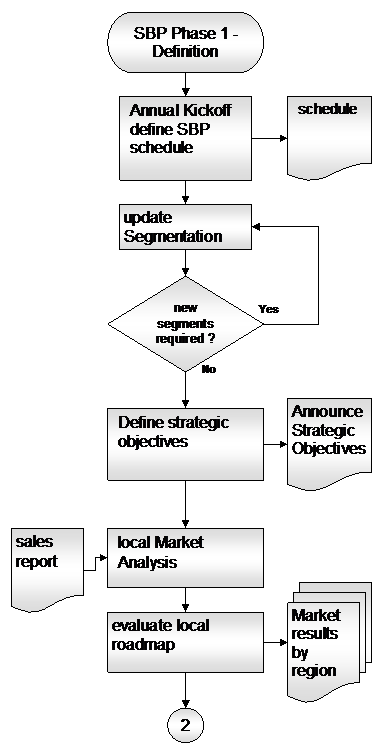
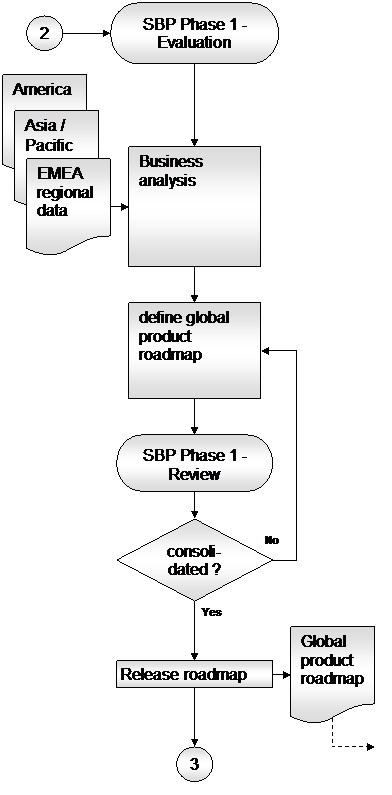
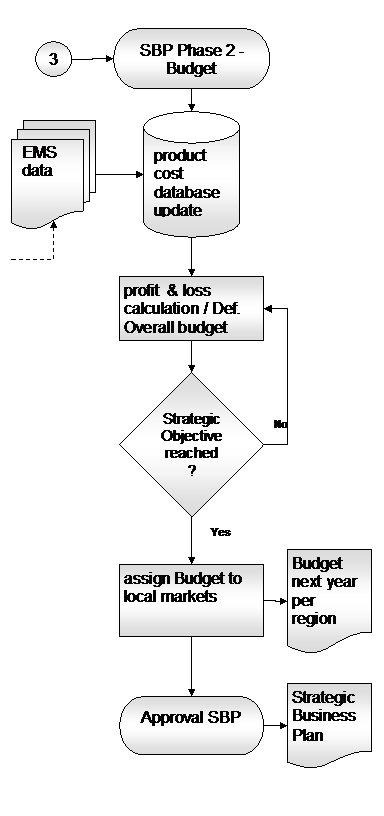
Section 2.3.1 will show the dedicated task in more detail and with references to deliverables, responsible persons and detailed task descriptions.
|
ê |
|
|
Strategic Committee |
|
|
Regions |
|
|
Global Product Marketing |
|
|
Global Supply Chain |
|
|
Finance |
|
|
Input |
Process |
Output |
Resp. |
Remark |
|
|
|
|
|
process owner: see section 2.4.1
|
|
|
|
|
|
see section 2.5.3 |
|
|
|
|
SC |
see section 2.2 |
|
|
|
|
|
see section 2.5.4 |
|
Input |
Process |
Output |
Resp. |
Remark |
|
|
|
|
|
process owner: |
|
|
|
|
MD GPM |
Inputs from regions: incorporate MD Template-Results in global business database and evaluate strategy |
|
|
|
|
GPM |
see section 2.5.5 distribute roadmap and distribute for review to MD |
|
|
|
|
MD |
Review Phase (by regions) |
|
|
|
|
GPM SC MD |
|
|
|
|
|
GPM GSC |
Distribution to GSC and Finance Interface to [3] Demand and Supply Process |
|
Input |
Process |
Output |
Resp. |
Remark |
|
|
|
|
Finance |
process owner: Finance |
|
|
|
|
GSC |
data from EMS Provider Interface from [3] Demand and Supply Process |
|
|
|
|
Finance |
Gross margin calculation |
|
|
|
|
SC |
to be reviewed by: - Finance, -SC, - ExCom |
|
|
|
|
Finance |
Distribution Budget to regions Outputs: - Budget Plan - balance sheets |
|
|
|
|
ExCom |
Distribution (Alan Moss) |
There are two kinds of deliverables
· Key Market Issues
· Strategic Forecast
The key market issues will be evaluated by each region. Output has to be summarized a PowerPoint slides with following topics:
· Summary of key issues relating to core business
· Review of top customers
· Review of current an new export markets
· Plan for local development of new segments with necessary resource allocation
· Plan for development of service activities
A three year market growth model has to be submitted by the regions based on the Market Analysis Template [3]. Market growth has to be break down to country level.
Also a three years volume and sales price list for product sales has to be submitted by the regions based on the Business Analysis Template [4].
Global Supply Chain has to incorporate these values in the overall database before final Presentation of the consolidated plan to the Executive Committee (ExCom).
The three year plan and the two-to-five year strategy will be reviewed and updated on an annual basis. The timeline of the considered year with the milestones (indicated on the picture below) will be announced at the beginning of each year by the Leader of the Strategic Committee (SC).
Within each evaluation period the following objectives have to be considered and have to be part of the annual reporting:
· Growth in market share
· Growing business per segment
· Increasing revenues from service activities
Inputs
· Market Size
· Competitive position
· local roadmap
· detailed sales forecast (three year basis)
Ones a year the strategic business unit
will perform a global analysis to evaluate the Strengths, Weaknesses, Opportunities, and Threats (SWOT)
of the Hypercom business.
Therefore the following items have to be considered:
· set objectives,
· generate alternative strategies,
· evaluate alternative strategies,
· monitor results
· gain commitment among the stakeholders during each step of this process

Results of the analysis will be summarized in the SWOT Analysis Template [8], which is also suitable for integration in a PowerPoint slide.
Market segmentation will be organized by product lines. Changes in segmentation will be controlled and announced by SC.
Following table shows the segments
based of 2008.
Note: Segmentation and product lines may slightly differ.
For an actual list of product lines refer to the following SharePoint URL:
|
Countertop |
Standalone
countertop payment terminals and PIN Pads supplied typically to banks and
operators for use by Tier 2-3 retailers |
|
|
Portable
and mobile payment terminals supplied through banks, operators and other
service providers, for use by hospitality organizations, delivery companies
etc. |
|
Multilane |
Multilane
interface devices, retail PIN Pads and payment software supplied typically to
multi-lane retailers (including hospitality) and software integrators |
|
Unattended |
Card
payment terminals and payment software supplied to machine integrators or
operators for integration in unattended vending and ticketing machines Encrypting
PIN Pads (EPP) supplied to Automated Teller Machine (ATM) manufacturers |
|
Networking |
Network
Access Controller (NAC) and other network management technology supplied to
banks and operators |
|
Healthcare |
Terminals,
card readers and software supplied to hospitals, doctors and pharmacies,
either directly or through integrators |
|
Services |
Basic
maintenance, logistics, help desk, management, downloading, hosting and
transaction routing |
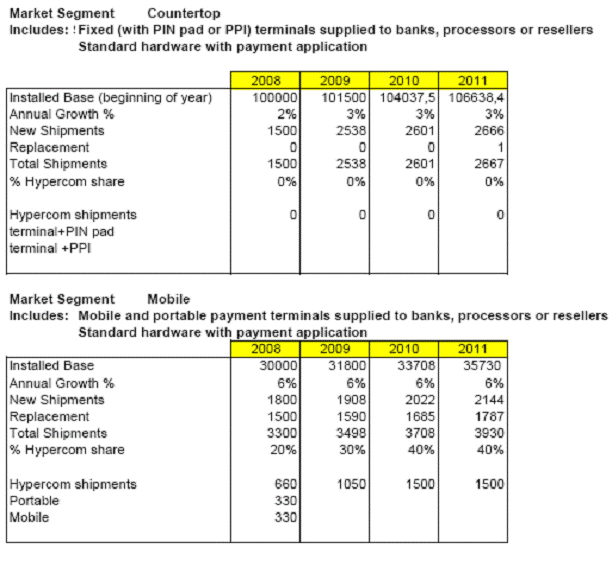
Market analysis will be performed by the regions. The Managing Director of each region is responsible that local Product Marketing will evaluate the local market trends, requests for new product families and definition of a local product roadmap will be ready in time as input for a global business analysis. Therefore a Market Analysis template [3] will be used for reporting.
These templates will be updated each year by Global Product Marketing and distributed together with an updated process schedule to the MD’s of the regions.
Market analysis will be performed by Global product Marketing. Based on the market growth model per country the GPM evaluates volume and sales price for product sales per country. Output will be also revenues and gross margins for service activities.
(t.b.d. – Alan Moss - detailed task description)
Review of the Business Analysis results will be performed between Global Product Marketing and the Managing Directors. This will be done region by region. Reviews will be scheduled due to the assigned timeline at SBP kickoff.
Global Supply Chain has to update the overall product database (Oracle based) with appropriate cost information. For new products the ‘EMS Partner Management’ within GSC has to make sure that required cost information in accordance with EMS Provider is complete and updated and that the EMS Partner commits to pricing and expected forecast.
(t.b.d.
– David Taylor – detailed task description)
Budget planning will be performed by Finance.
(t.b.d.
– Bob Vreeland – detailed task description)
(t.b.d.
– Alan Moss - a short description which parts the SBP documents contains)
Note: Only these kinds of stakeholders responsibilities are described here which are related to the strategic business planning process.
|
Stakeholders |
Responsibility |
|
Executive Committee (ExCom) |
Develop and
execute the strategy and strategic plan of the Company as approved by
Hypercom’s Board of Directors. |
|
Strategic Committee |
Establish the
Company’s three year plan and |
|
Global Product Marketing |
Definition of
Strategic Global Product Roadmap. Evaluation of
technical and market strategic trends. Support to Local
Product Manager for breakdown regional product roadmaps. |
|
Managing Directors |
The Managing
Director for each region is responsible to coordinate the local roadmap
processing. He reports the local business plan summaries to the Strategic
Business Unit. |
|
Definition of
strategic objectives and time schedule for the strategic business planning on
an annual basis. Business analysis
based on consolidated product roadmaps by regions. |
|
|
Global Supply Chain |
t.b.d. (Ron
Rhodes / David Taylor), |
|
Finance |
Performing
Profit & Loss (P&L) scenarios and Balance sheet. Budget planning for
board approval (ExCom) within the strategic Business Process. t.b.d (Bob
Vreeland) |
In alphabetic order
|
Term |
Description |
|
EMEA |
Hypercom region covering Europe, Middle East and |
|
|
Electronic Manufacturing
Services |
|
SWOT |
Strengths, Weaknesses, Opportunities, and Threats |
|
SC |
Strategic Committee |
Following table will only be available in this document for status ‘Draft’ or if as ‘released’ marked version is under review. This section has to be deleted at the time it will be released and distributed by the last author.
|
Action Item |
Description |
Person |
due date |
|
1 |
assign people for
support and review (GPM part) |
|
closed |
|
2 |
Definition of.
abbr. NAC in SBP slides |
Alan Moss |
closed |
|
4 |
segmentation
does not match with actual HYC Internet product portfolio presentation |
Alan Moss |
closed |
|
5 |
doc standard for
future Web-based presentation (Requested by Arnd
Hanstein) |
Michael Gries |
closed |
|
6 |
Interworking SSC
(“database with cost information”) |
Achim Lehmann |
open |
|
7 |
roles
description GSC |
David Taylor |
open |
|
8 |
process layout
adaptation / harmonization |
Arnd Hanstein |
closed |
|
9 |
internal QM
review |
Siegfried Götz |
closed |
|
10 |
Definition SBP
related resp. of Finance |
Bob Vreeland |
open |
|
|
|
|
|
Following examples illustrates the ongoing process
Note:
For each Market segment the table and input data will differ depending on the different products within the product line. Following are different examples of two segments:
…